Showing posts with label Bio 9-Homeostatsis. Show all posts

Monday, 23 March 2009

Urine Production In Kidney

Picture Source:http://www.ivy-rose.co.uk/Topics/Urinary_System_Nephron_Diagram.php

Urine Production in kidney occurs in 3 stages:

Ultrafiltration, Reabsorption and Secretion.

Ultrafiltration
-Afferent Arteriole transport blood into glomerulus while Efferent Arteriole transport blood away from glomerulus.
-Afferent Arteriole has bigger diameter than Efferent Arteriole.
-Rate of blood flow into glomerulus through Afferent Arteriole is higher compared to rate of blood flow out of glomerulus through Efferent Arteriole.
-The difference in rate of blood flow facilitates creation of high hydrostatic pressure in glomurulus.
-The pressure created causes blood from glomerulus to be filtered into Bowman’s capsule across endothelium and Bowman’s capsule’s wall.
-Ultrafiltration Occurs.
-Fluid formed in Bowman’s Capsule is Glomerular Filtrate.
-Filtrate has same composition with blood except it lacks Red Blood Cells, Plasma Protein and Platelets which are too large to be filtered across endothelium.
-Ultrafiltration is facilitated by these adaptation:
.Blood that flows through afferent arteriole has high pressure as it is directly connected to aorta though renal artery.
.Presence of podocytes that wraps around capillaries in glomerulus to increase surface area for ultrafiltration.
.Both endothelium and Bowman’s Capsule wall are one-cell thick each, the wall is made of squamous epithelial cell.

Reabsorption:
-From Bowman’s Capsule, filtrate flows into proximal convoluted tubule in which reabsorption process occurs.

-Selected substances from filtrate in tubule are reabsorb into blood in peritubular capillary.
-Examples of substances reabsorb are:
.100% of nutrients such as glucose and amino acids through active transport and facilitated diffusion.
.Minerals such as Na+ ion through active transport.
.Water through osmosis.
-Adaptation:
.Highly convoluted to increase surface area.
.Microvilli on surface of epithelial cells that is facing into lumen of proximal convoluted tubule.
.The epithelial cells have high density of mitochondrion to generate energy for active transport.

Counter current multiplier process:
-Descending arm is permeable to water while ascending arm is NOT permeable to water.
-Na+ and Cl- diffuses out of filtrate into medulla region in the thinner segment of ascending arm.
-These ion are actively transported into medulla region from thicker segment of ascending arm
-These processes lower water potential of medulla region.
-Water in filtrate in descending arm diffuses into medulla region and then into blood in vasa recta (capillaries in medulla) through osmosis.
-Reabsorption of water in Loop of Henle occurs through counter-current multiplier process.
-Adaptation- the longer rhe Loop of Henle , the more water reabsorb into capillary.

Secretion:
-Fom Loop of Henle, filtrate flows into distal convoluted tubule in which active secretion process occurs.
-Excretory substances such as urea, uric acid, ammonia, excess H+ ions, drugs and other substances are actively secreted from blood in peritubular capillaries into filtrate in the tubule(distal).
-This process enables kidney to function as an excretory organ.
-From distal convoluted tubule, filtrate flows into collecting duct in which more reabosorption of water occurs before the filtrate flows into pelvis of urine.

Monday, 16 March 2009

Glocose Regulation

Glucose Regulation
-Normal Blood Glucose level in human is 80-100mg/100ml of blood.

When blood glucose level is Higher than normal range:
1.Increase in blood glucose level above normal range is detected by beta-cells of Islet of Langerhans in pancreas.
2.Beta-cells secrete Insulin into blood circulation
3.Insulin cause these reaction:
a)Stimulate absorption of glucose into body cells from blood.
b)Stimulate metabolism of glucose in body cells.
c)Stimulate glycogenosis in liver and muscle cells in which excess glucose goes through condensation to from Glycogen which are then stored.
d)Stimulate conversion of excess glucose into fats in liver and adipose tissue to be stored.
e)Reduces rate of glucogenolysis which is the break down of glycogen into glucose in liver.
f)Reduces rate of gluconeogenesis which is synthesis of glucose from non carbohydrate substance in liver.
All of these processes reduces blood glucose level back to normal range.

When Blood Glucose level Lower than normal range:
1.Decrease in blood glucose level is detected by Alpha-cells of Islet if Langerhans in pancreas.
2.Alpha-cells secrete Glucagon into blood circulation.
3.Glucagon causes these reaction:
a)Stimulate break down of glycogen into glucose in liver cells, glycogenolysis occurs.
b)Stimulate conversion of non-carbohydrate substance such as fat into glucose-gluconeogenesis.
c)Stimulate release of glucose from liver cells into blood circulation.
d)Reduce rate of glycogenesis in liver.
All of these processes increases blood glucose level back to normal range.

Disease related to Blood Glucose Level in Human
-Diabetis mellitus(high blood sugar) occurs when blood glucose level is more than 100mg per 100ml of blood and glucose is found in urine.
-Diabetis mellitus is divided into 2 types:
Type I
.Destruction of Beta-cells of Islet of Langerhans reduces produciton of Insulin.
.Patients can be helped by injection of Insulin.
Type II
.Insulin production is normal, but target cells especially liver cells fail to respond to insulin.
.Injection of Insulin does not cure the symptoms.

-Hyperglycemia-Blood glucose level is more than 100mg per 100ml of blood but glucose is not found in urine.

-Glycosuria-Glucose is found in the urine.
.Too much of glucose in blood results in high concentration of glucose in glomerulus after ultrafiltration.
.Excess glucose in glomerulus filtrate cannot be reabsorbed into blood capillary and ends in urine.

-Immunological functions disease-longer time for blood clotting and lower immunity response.

Sunday, 15 March 2009

Structure and Functions of Liver


STRUCTURE OF LIVER
-Liver consist of many lobes.
-Two blood vessels supply blood to liver and one drains blood away from it:
>Hepatic Artery-Supply oxygenated blood to liver.
>Hepatic Portal Vein-Supply blood from intestine transporting water soluble digested nutrients to liver.
>Hepatic Vein-Drain blood away from the liver transporting deoxygenated blood back to heart.
-Branches from hepatic arteries and hepatic portal veins enter into the lobules from portal region.
-Bile canaliculi transport bile to bile ducts found in portal region.
-Bile from bile duct is later channelled to gall bladder.
-Liver cells called hepatocytes are arranged in strands radiating from central vein towards the periphery.
-Central vein collects blood away from the lobule.
-Each lobule is supplied with blood from hepatic arteriole and hepatic portal vein, which fuse to form many capillaries called sinusoids and flow to the central vein.
-Special amoeboid cells called Kupffer cells are attached to the inner wall of sinusoids for phagocytosis of old red blood cells and pathogens.
-Bile is produced in the hepatocytes and secreted into canaluculus which them empties bile into bile ducts.
-Bile is collected by the gall bladder for temporary storage before it is emptied into the duodenum.


FUNCTION OF LIVER

1.Regulates blood glucose level at 80-100mg/100ml of blood.
a)Stimulate condensation of excess glucose into glycogen which is then stored-Glycogenesis-occurs in the present of insulin.
b)Stimulate break down of glycogen into glucose in the present of glucagon-Glycogenolysis.
c)Stimulate synthesis of glucose from non-carbohydrate substances such as fat through Gluconeogenesis.
d)Release glucose into blood circulation if blood glucose level becomes lower than normal range.
e)Stimulates conversion of lactate (lactic acid) produced through anaerobic respiration in skeletal muscle cell into glucose. The lactate may also be broken down to produce energy lactate from skeletal muscles are transported to liver through Cori Cycle.

2
.Regulates body protein level
a)Excess amino acid goes through deamination in liver to produce ammonia and keto acid.

b)Ammonia produced through deamination is converted into urea through Ornithine Cycle.
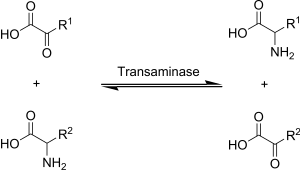
c)Synthesis of non-essential amino acid through transamination.

3
.Regulates lipid level in body
a)Does synthesis and break down of steroids such as cholesterol.
b)Does synthesis of fat-lipogenesis
c)Break down of fat.

4
.Does detoxification in which toxic substance such as alcohol are converted into non-toxic substances.
5.Synthesis of plasma protein such as prothrombin.
6.Synthesis of Red Blood cells in foetus stage.
7.Acts as reservoir of blood.
8.Stores nutrients such as vitamin A, D, B12 and minerals such as Fe2+ ions.
9.Synthesis of bile which is used for emulsification of fat in duodenum.

Cori Cycle
-Through anaerobic respiration/lactate fermentation, skeletal muscles produce lactate.
-Lactate produced in the muscles are transported to the liver by blood circulation.
-In liver, lactate may be broken down to produce energy or converted back into glucose.
-Glucose produced can be transported back to muscles or stored as glycogen.

Ornithine Cycle
-is a process involved in conversion of ammonia into urea.
-Ammonia produced through deamination is bind with CO2, H2O and phosphate group using energy to form Carbomoyl Phosphate.
-This process occurs in matrix of Mitochondrion.
-Carbomoyl phosphate binds with Ornithine and then releases phosphate group to forum Citruline.
-Citruline is transported into cytoplasm, it binds with Aspartate to form Argnininosuccinate.
-Argininosuccinatre splits to form fumerate and arginine.
-Hydrolysis of Arginine produces urea and regenerates Ornithine.
-Ornithine is transported into matrix of mitochondria and the processes are repeated.

Break down of Red Blood Cells
-Old/worn-out Red Blood Cells are destroyed by Kupffer cells in liver.
-Haemoglobin is broken in liver cells to produce Haem and Globin.
-Globin(tertiary structure protein) are hydrolysed to produce amino acids which are then reused.
-Haem is broken down to produce Porphyrin ring and Iron ion.
-Porphyrin rings are broken down and use for synthesis of bile pigments, bilirubin and biliverdin.
-Bile pigments are used in synthesis of bile.
-The Iron ions are stored in liver as Ferrifin or transported back to bone marrow as iron-transferrin complex.

Saturday, 14 March 2009

Regulation of Body Temperature


Regulation of Body Temperature by Endothermic Organisms
-Endothermic organisms are organism that generate heat internally in body to maintain body temperature.

Body Temperature is Higher than Normal Range:
-Increase in body temperature is detected by thermoreceptor in Hypothlamus while increase in external environment temperature is detected by thermoreceptor in skin.
-Temperature regulatory centre in hypothalamus receives impulse from the thermoreceptor
-Temperature regulatory centre transmit impulse to these effectors:
>Erector muscles in skin relaxes, hair on sin becomes slanted. Thinner layer of air is trapped among hair on skin. More heat is lost through surface of skin to produce cooling effect.
>Vasodilation of blood vessels in skin region occurs to increase rate of blood flow. Since blood transport heat, more heat is transported to skin region, more heat is lost through skin.
>Sweat glands in skin secretes sweat to surface of skin. Vapourisation of sweat releases latent heat of vaporisation, cooling effect occurs.
-All these processes increases heat lost from the body, body temperature decreases back to normal range.

Body Temperature Lower than normal range:
-Decrease in body temperature is detected by thermoreptor in Hypothalamus and decrease in external environment temperature is detected by thermoreceptor in skin.
-Temperature regulatory centre in hypothalamus receives impulses from the thermoreceptor.
-Temperature regulatory centre transmit impulse to these effectors:
>Erector muscle in skin contracts, hair on skin becomes erect. Thicker layer of air is trapped among hair on skin. The layer of air acts as insulating layer to reduce heat lost through skin.
>Vasoconstriction of blood vessles in skin occurs to reduce rate of blood flow to skin region. Less heat is transported to skin region, less heat is lost through skin.
>Medulla oblongata stimulates alternate contraction and relaxation of skeletal muscles, shievering occurs. Contraction of muscles releases heat that can be used to maintain body temperature.
>Adrenal gland secretes adrenaline to stimulates hydrolysis of glycogen in liver to glucose. Glucose produced is released into blood circulation to be used in energy/heat production.
>Thyroid gland secretes thyroxine to increase body metabolic rate. More heat is produced through metabolism to maintain body temperature.
- All of these processes decreases heat lost from body, body temperature increases back to normal range.


Regulation of Body Temperature by Ectothermic Organisms
-Ectotherms or poikiloterms include insects, reptiles, fish and amphibians.
-Ectotherms are animals that regulate temperature by receiving heat exogenously from sunlight.
-Their body temperature follow that of the external temperature (environment)
-Ectotherms control body temperatures by behavioural changes and not by physiological methods.
-Eg of behaviour changes of ectotherms to regulate body temperature:
i) Orientate body towards/away from sun rays to absorb/reduce absorption of heat-when body temperature is low/high.
ii) Move to warmer surface to absorb heat.
iii) Have body colouration to absorb or release heat- dark colours to absorb heat and pale colours reduce heat absorption.
iv)Move into water or burrow to absorb heat.
v)Remain dormant(inactive) or diapauses throughout winter.
vi)Painting or opened mouth to release heat by evaporation.

Homeostasis

Homeostasis
-is a process of maintaining constant physical and chemical factors within an internal environment to ensure survival of body cells.
-Internal environment refers to environment surrounding the cell which consist of tissue fluid(interstitial fluid), plasma and lymph.
-Factors involved in homeostasis are:
i)Physical factors- body temp, blood pressure, osmotic pressure.
ii)Chemical factors- blood pH value, glucose and mineral(salt), concentration of blood.
-The organ involved in homeostasis are:
>Receptors- special cell that can detect changes in certain factor and an impulse is generated to be sent to central nervous system (usually the brain)
>Control centre- control centre that receives impulses from receptors, coordinates them and sends action signals (impulses or hormones) to the effectors or target organs.
>Effectors- muscle or gland that corrects the changes in the internal environment after receiving impulse from the control center.

Importance of Homeostasis
-Life of organism becomes less dependent on external environment because the organism is able to control changes in its internal environment to compensate for changes in external conditions.
-Ensures an optimum internal environment for cells to function, the organism to survive and reproduce efficiently.
-Enables biological systems to function efficiently and smoothly with minimum wastage of energy.
-The organism can live in wider range of habitats because the species can live in areas with variable conditions.
-The organism can increase or decrease the metabolic rate of its body according to its requirements.

Negative feedback mechanism
-Regulatory mechanism that's used to restore the body to its original constant state after it has been affected by any disturbance.
-If the physiological parameter were raised/lowered, a process would take place to reduce/increase the parameter involved.

Positive feedback mechanism
-Mechanism that is seldom used as it creates further extreme to the changes that has occurred.
-If a physiological parameter were increased/lowered, positive feedback would further increase/lower the factor.
-Eg: Action of hormone.
Free Hit Counter